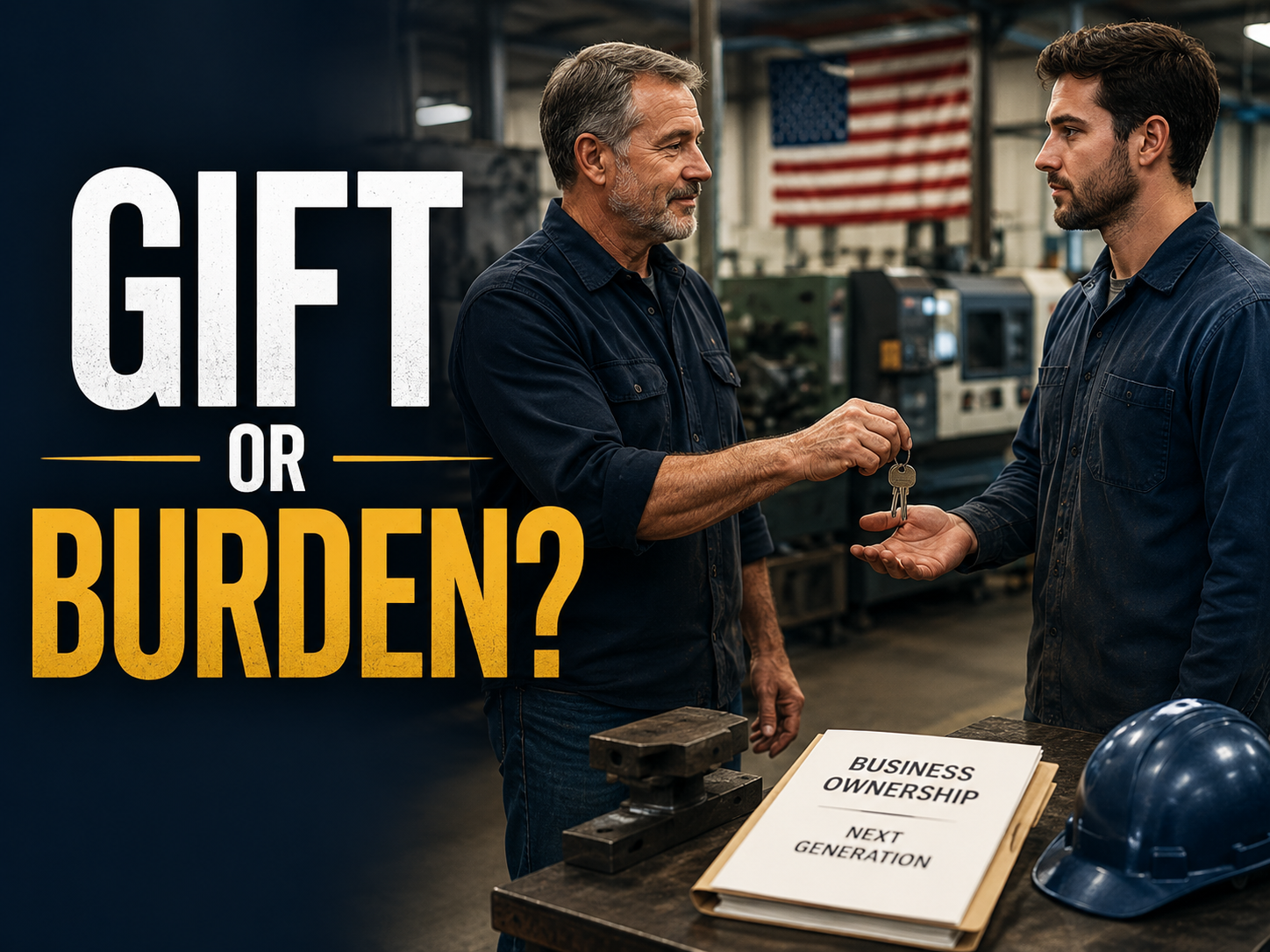
Leaving Your Business to Your Children: Gift or Burden?
The Assumption That Gets Owners Into Trouble
Many business owners assume that their children or heirs will want their business when they’re no longer alive. Sometimes they assume that even if the heirs aren’t currently involved in the business. However, that can be an assumption that will leave a trail of tears and torn relationships rather than a benefit. If that assumption isn’t made public while the owner is alive, it will be too late to choose a different course.
Leaving a business to your children or heirs is one of the most consequential decisions you will make as an owner. It deserves more than an assumption. It shouldn’t be a surprise. It deserves a real conversation and a clear-eyed look at three things: whether your heir wants it, whether they’re capable of running it or creating a plan for the operation of the business, and whether the business can even function without you.
The Obligation Trap: When Loyalty Masquerades as Desire
Your children grew up watching you sacrifice nights and weekends for this business. That creates something powerful and potentially problematic. The loyalty they feel toward what you built can look a lot like desire, even when it isn’t. The result is an heir who may say yes because it feels like the right thing to do, not because they’re built for it.
That’s the obligation trap. And it’s worth naming before it becomes your succession plan. An heir running a business they resent or aren’t qualified to run will make short-term decisions, neglect the relationships you spent years building, and eventually disengage. What took you thirty years to build will erode in a few years. An honest conversation, while you’re still alive to have it, protects both your legacy, your relationships, and your heirs’ relationships.
Desire Is the First Question. Capability Is the Second.
Before you talk about what your heir can do, you need to know whether they want to. These are different questions and both matter.
An heir who genuinely wants the business but lacks certain skills can be trained. Gaps in financial management, operations, or sales can be filled over time if the motivation is real. But wanting the business isn’t enough on its own. They also need a credible plan for running it, either by developing the skills themselves or by building a leadership team that fills the gaps they cannot.
The honest conversations need to take place before you build a succession plan around an assumption. Not just a casual mention at a family dinner. A real conversation where there’s time and space to have a dialog and where the answer is genuinely allowed to be no.
Your Business Was Your Calling. Not Necessarily Theirs.
You built this company because something in you wanted or needed to build it. The hours you put in, the problems you solved, the customers you kept through the hard years. That was your calling. Your identity is woven into this business in ways you won’t fully recognize. That doesn’t transfer by bloodline.
Your child will be talented, motivated, and hardworking and still not be called to run an industrial services company or a manufacturing shop. That’s not a failure of parenting. It isn’t a failure of them. Acknowledging it early and creating space for an honest answer is one of the most generous things you’ll do as a business owner and as a parent.
The Invisible Owner Problem
Even if your heir wants the business and has a plan to run it, there’s a third question many succession plans overlook: will the business function without you?
You are doing things every single day that aren’t written down anywhere and that nobody has been trained to do. You are managing key customer relationships informally. You are keeping a critical employee engaged through personal loyalty to you specifically. You are reading vendors and knowing which ones to push and which ones to give room. You are the institutional knowledge of the business, and none of it is documented.
This is what I call the invisible owner problem. The question to ask is this: what would stop working if you weren’t there? The answer to that question is the real capability gap, and it has nothing to do with your heir’s talent. The good news is that if you’ll identify it while you can and put in the work to document it, then a succession will be viable.
A Clean Sale Is a Legitimate Option
If the honest answer is that your heir doesn’t want the business, doesn’t have a credible plan to run it, or if you’ve realized how dependent the business is on you personally, a clean sale will be the most generous decision you’ll make.
If you decide to sell the business, it’s important to still have a conversation with your children or heirs if they work in the business. I once worked with an owner who wouldn’t have that conversation about selling with his son who led the shop floor. The son must have begun to sense something was in motion, even though our meetings were after hours and our communication was private. I can’t say for certain what triggered the shift, but sales and productivity slipped, and the value of the business eroded to the point where a viable sale was no longer possible.
A business sold at fair market value while it’s still performing well gives your family real liquidity. It gives your employees stability under committed new ownership. And it gives you an exit on your terms. That’s not a failure of family legacy. That’s wise planning.
If you’re starting to ask these questions and the answers are less certain than you’d like, a confidential conversation with an advisor is a useful next step. Brent Pennington at Metroport Industrial Advisors works with business owners in exactly this position. The conversation is free and usually clarifying. Reach out at brent@metroportadvisors.com or 817-999-8266.
About the Author
Brent Pennington, CCIM | Advisor, Senior Vice President
Metroport Industrial Advisors and Metroport Commercial Group (eXp Commercial)
Brent Pennington, CCIM, is an Advisor, Senior Vice President with Metroport Industrial Advisors and Metroport Commercial Group (eXp Commercial), specializing in industrial and flex properties and tenants across the Dallas-Fort Worth metroplex and advisory services nationwide. A Baylor University graduate with degrees in Accounting and Entrepreneurship, Brent brings a rare combination of financial literacy and operational credibility to every client engagement.
With 35+ years of prior experience as a business owner in manufacturing, distribution, and retail, he understands industrial real estate from both sides of the transaction as the operator who occupied the space and as the advisor who guides owners through dispositions, acquisitions, leasing strategy, 1031 exchanges, and sale-leaseback structures. That dual perspective gives his clients something many brokers can’t offer: counsel grounded in how a building functions as a business asset.
Brent serves industrial property owners across the DFW submarkets of Plano, McKinney, Allen, Richardson, Garland, and Northeast Dallas with a particular focus on long-term owners approaching a business transition, generational wealth transfer, or exit from active management. His nationwide industrial advisory approach is grounded in biblical stewardship principles, helping owners make decisions that honor both their financial legacy and their long-term values.
As a member of NTCAR and holder of the CCIM designation, the commercial real estate industry’s most rigorous analytical credential, Brent is a recognized thought leader on North Texas industrial market trends, owner exit strategies, and CRE wealth preservation.
Connect with Brent at 817-999-8266 | brent@metroportadvisors.com | metroportadvisors.com
The content on this site is provided for informational purposes only and does not constitute legal, financial, tax, or investment advice. Commercial real estate transactions involve complex variables that differ by property, market, and individual circumstance. Readers should consult qualified legal, tax, and financial professionals before making any real estate or business decision. Brent Pennington, CCIM, and Metroport Commercial Group (eXp Commercial) make no representations regarding the accuracy or completeness of information presented and assume no liability for decisions made in reliance on this content. All market information reflects conditions at the time of publication and is subject to change.
Frequently Asked Questions
How do I know if my child wants to run the business?
Ask directly and not just once. Schedule a meeting and have a real conversation where they feel genuinely safe to say no. Give your children or heirs the space to process the ideas after your meeting. The loyalty many children feel toward a parent’s business will mask their true feelings. An M&A advisor will help structure this conversation more objectively.
What is the invisible owner problem in business succession?
It refers to everything a founder does that is undocumented and untrained: customer relationships, vendor terms, employee loyalty, institutional knowledge. These things won’t transfer automatically in a succession if they aren’t documented, and identifying them early is critical to any viable transition plan.
What if my heir wants the business but won’t be ready to run it?
The right move is an honest capability assessment, not an assumption. Many successful transitions involve an heir working in the business for two to five years before taking full ownership, building relationships and skills incrementally. An advisor will help structure a realistic timeline.
Is leaving a business to heirs always the right choice?
Not at all. A business sold while healthy generates real liquidity for your family. A business passed to an heir who isn’t suited for it will erode in value quickly for the heir and possibly for the rest of the family. Both paths can be right. The key is choosing deliberately rather than defaulting to inaction or an assumption.
How do I start planning for business succession?
Start with the conversation before the documents. Talk to your potential heir honestly. Then get an objective assessment of what the business is worth and what it would take to run it without you. A business advisor and an estate attorney working together will help structure the rest.